
Terni is a city synonymous with industry and work, too often overlooked by those visiting Umbria. On the contrary, it hides unexpected artistic and architectural treasures and a historical and cultural stratification unique of its kind in all of Central Italy. A city with a millennial history where every period has left important traces, from the ancient Naharti to the experiments of Mario Ridolfi, it offers the visitor a modern urban structure that preserves a historical heart with medieval and Renaissance characteristics. The surroundings are all to be discovered, with unmissable natural places like the Marmore Waterfall and Lake Piediluco and historical sites of great interest like the ruins of Carsulae or the ancient arx of Sant'Erasmo.
10 things to do
.jpg)
1. Piazza Tacito, heart of the modern city
The square dedicated to the Roman historian Tacitus, who a consolidated local tradition claims was originally from Terni, constitutes the beating heart of the modern city. At the center is one of the symbols of the city: the Zodiac fountain, a work by Mario Ridolfi with mosaics by Cagli.
2. Corso Tacito, the street of commerce and encounters
The city's main street, also called Strada Nova, was opened in the medieval fabric at the end of the 19th century to connect the city center with the railway station. It immediately became the street of elegant commerce, the residences of the new middle class, and the place for strolling. It preserves many elegant buildings from the early twentieth century, among which the most notable is certainly Palazzo Montani-Leoni, headquarters of the Fondazione Carit, which periodically hosts exhibitions of great interest.
3. Piazza Duomo, religious and artistic heart of the city
A secluded and silent square, rich in history, defined by the episcopal complex and the cathedral of Santa Maria Assunta. The church has a Baroque appearance but hides older evidence such as the suggestive Romanesque crypt or the remains of an early medieval chapel under the elegant portico. Splendid is the eighteenth-century altar by Carlo Murena flanked by a monumental Baroque organ whose design is attributed to Bernini. There is no shortage of contemporary works such as the frescoes of the Chapel of Santa Maria Madre di Dio, in neo-Byzantine style by two Russian artists, and the large and controversial fresco of the Resurrection by the Argentine painter Cinalli. The nearby building of the Former Seminary houses the Diocesan and Capitular Museum, rich in Renaissance and Baroque sacred art.
4. Church of San Francesco, Via Fratini and Piazza dell'Olmo
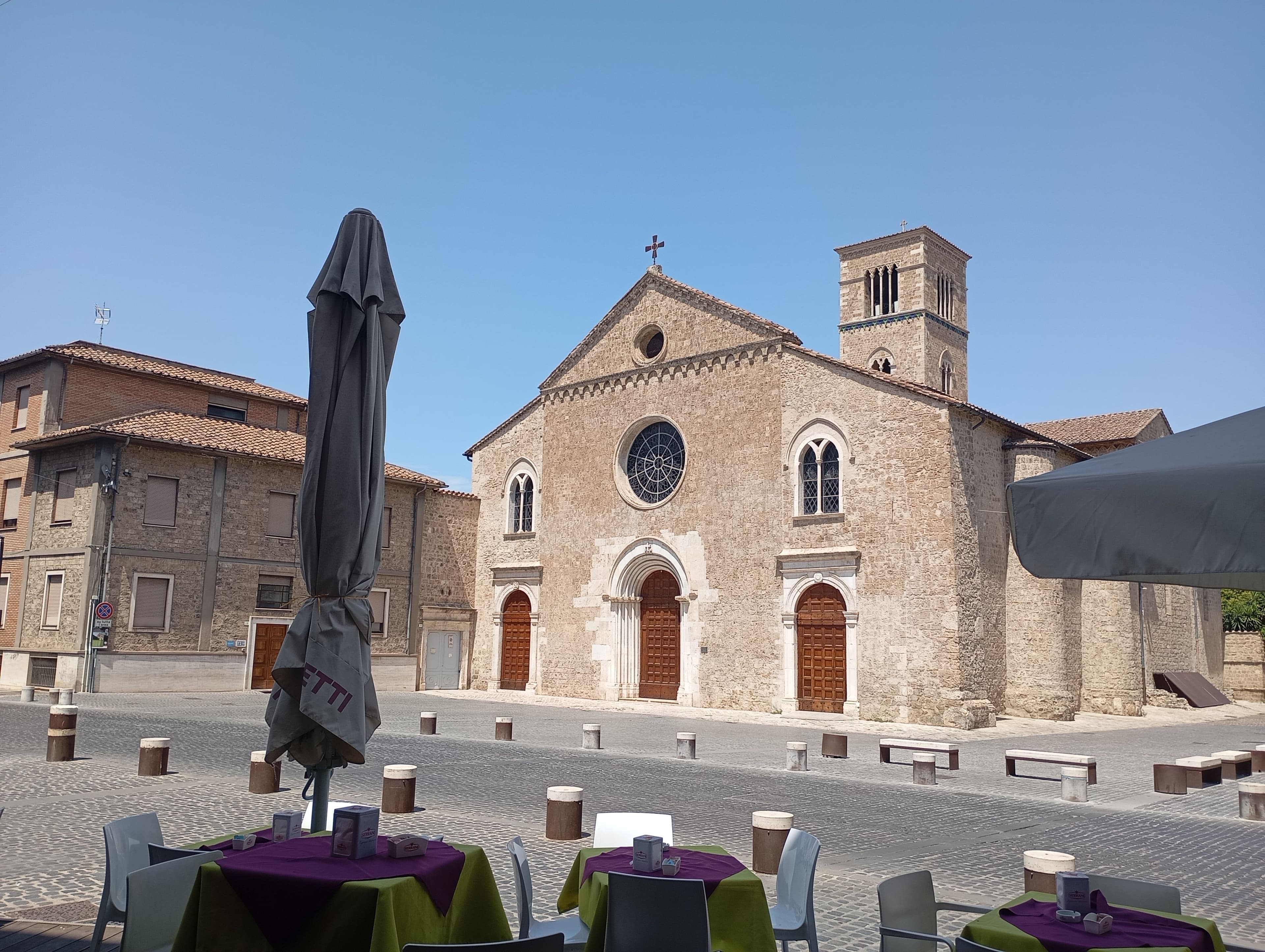
The church represents a Gothic jewel, built on the model of the Basilica of Santa Chiara in Assisi. Over the centuries, side aisles were added and it was enriched with numerous works of art. The interior is simple and solemn. Do not miss the Paradisi Chapel with its wonderful late Gothic frescoes by Bartolomeo di Tommaso, depicting the Last Judgment. The nearby Via Fratini and Piazza dell'Olmo constitute the heart of the so-called Movida, with many bars and cafes where it is possible to have an aperitif or spend an evening in trendy places.
5. Caos Museum Center and Città Giardino
The ancient Papal Ironworks, opened at the end of the 1700s, has been renovated and transformed into a modern and lively cultural center, with a theater, the archaeological museum with a rich pre-Roman and Roman collection, the gallery of modern and contemporary art with ancient works and works by contemporary masters and local artists such as Metelli and De Felice. Furthermore, there are spaces for temporary exhibitions and a cafeteria that is always very popular. A few steps from the exhibition center, the characteristic neighborhood of Città Giardino is worth a walk, full of Art Nouveau houses and dominated by the mass of the Church of the Sacred Heart.
6. Piazza Clai and medieval area
The ancient Piazza Clai represents the heart of a neighborhood that still preserves many features and buildings from the medieval era. Once a popular and artisan area of the ancient city, recovered with a skillful restoration, it is today a residential area rich in suggestive views with underpasses and tower houses.
7. Roman Amphitheater and Giardini de La Passeggiata
One can admire the largest preserved monument of Roman Interamna, one of the oldest masonry amphitheaters, with an archaic typology that precedes the monumental buildings of the imperial era. Even today it is used as a performance venue, especially in the summer period. Over the centuries, medieval and modern constructions were built on its perimeter, including the beautiful church of Santa Maria del Carmine, now a space for cultural events. Around the monument unfold the ancient gardens of the Passeggiata, planted in the nineteenth century, which represent the main green area of the city center, enriched with ancient fragments of monuments now lost.
8. Palazzo Spada and Church of San Salvatore
The monumental Renaissance palace, built by Michelangelo Spada based on a design by Antonio da Sangallo the Younger, is today the municipal seat. In the courtyard, it houses the sculpture of the Thyrus, the dragon symbol of the city. A few steps away stands the ancient church of San Salvatore, one of the most characteristic monuments of the city. Built on a Roman domus, it has an original shape consisting of a circular structure covered by a dome and a short nave. Due to its shape, it is also known as the Temple of the Sun.
9. Basilica of San Valentino
Just outside the historic center, the Basilica dedicated to the Saint of Love is worth a visit. Built on an ancient Roman burial site, it was rebuilt in the early seventeenth century with the discovery of the Saint's body. The interior is rich in works of art, with a high altar financed by the Habsburgs, which shows a precious reliquary statue of Saint Valentine.
10. Architectures of Ridolfi and contemporary art
Devastated by bombings, the reconstruction of Terni saw the involvement of famous architects and artists. In the city center, you can admire many architectures by Mario Ridolfi, one of the masters of modern Italian architecture. An itinerary that touches the Leonardo Da Vinci middle school, the Casa Chitarrini, the Palazzo Briganti, up to the arrangement of Corso del Popolo. Many works of contemporary art are also scattered throughout the center. Among all, the Lancia di Luce obelisk by Arnaldo Pomodoro is unmissable.
Where to eat and drink

Eating in Terni is something that is taken very seriously. In the city center, there are many places for all tastes.
There is a great tradition of pizza by the slice. You must absolutely try the pizza grassa, a typical pizza enriched with cheese and diced ham. Therefore, an unmissable stop is Elio, a historic bakery in Piazza Solferino.
For a coffee and a break, Caffè Pazzaglia is highly recommended, one of the historic places in the city, where to see and be seen in the very central Corso Tacito, with a rich choice of pastries.
If you then want to stop for a quick break, even if we are not in Romagna, the piadinas and crepes of Crepsmania in Via Tiacci deserve to be tasted.
To be tasted in every season is the excellent gelato from Gelateria Europa in Piazza Europa or Da Andrea in Via Mancini.
If you then want to eat something local, Trattoria La Mora in strada di San Martino is highly recommended, where you can taste excellent ciriole alla ternana.
If you then want a more modern and trendy place, a stop at Macelleria Pucci in Via Piave is unmissable. A historic butcher shop has been transformed into a contemporary grill house, where you can enjoy a rich selection of excellent meat.
If you still have a craving for something sweet, you must absolutely taste the cream tart from Pasticceria Modernissima in Viale Cesare Battisti.
For after dinner, Terrazza Elettra in Via Fratini or Met in Piazza Tacito are worth a stop.
Where to stay
Not being a strictly tourist city, there are not too many choices regarding the areas in which to stay. Most hotels are located near the railway station from which the center is easily accessed and public transport can be used for excursions in the surroundings. If you prefer private accommodation, in the city center there are several holiday homes and bed & breakfasts to choose from.
Good to know before leaving
Terni is easily reachable by train or by car with good connections to the motorway network. For a visit to the city, one day can certainly be sufficient, but at least another day should be dedicated to discovering the surroundings. Do not miss an excursion to the Marmore Waterfall, one of the highest in Europe, or a boat trip on Lake Piediluco, ending with a walk through the ruins of the Roman city of Carsulae.