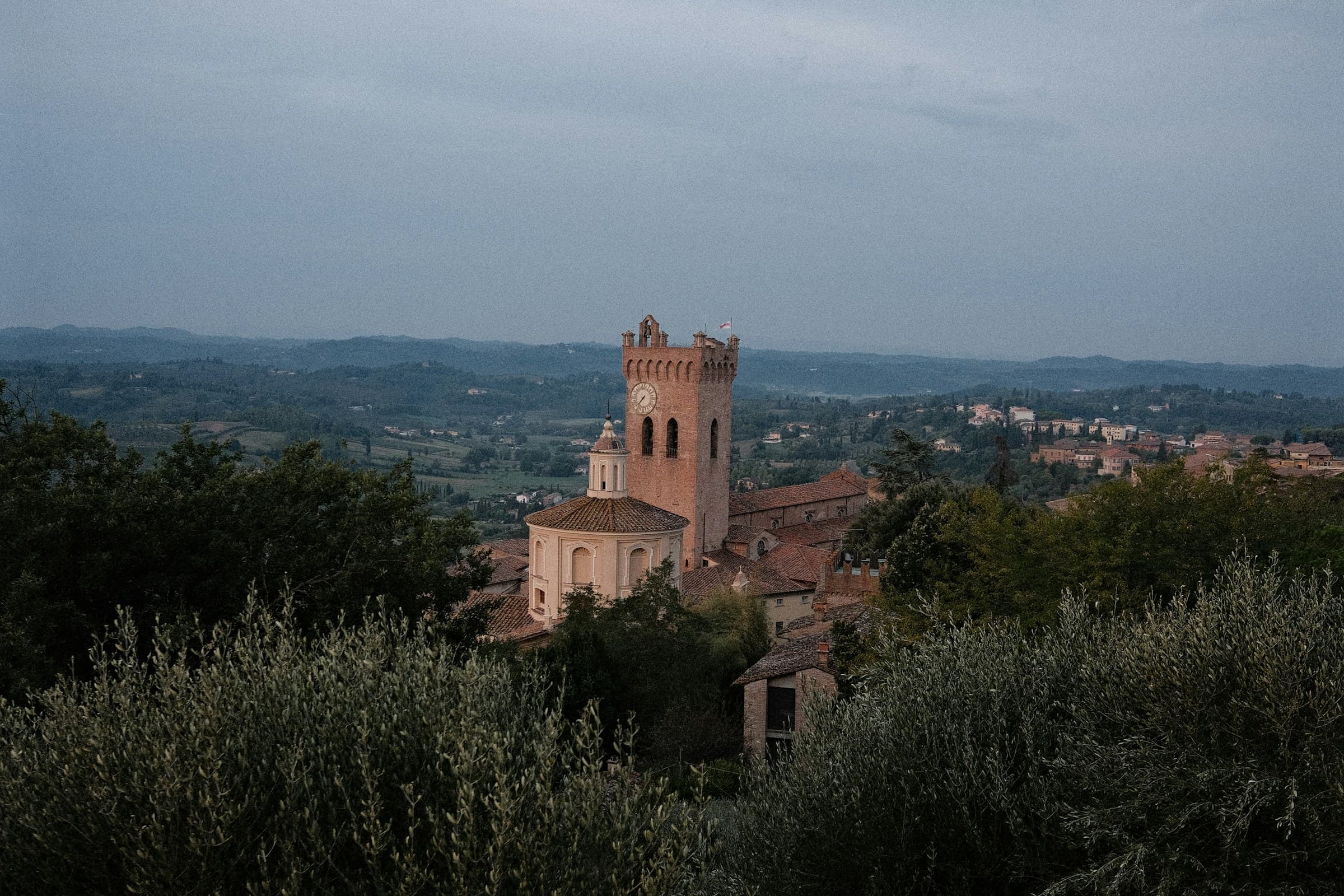
San Miniato is a city and commune in the province of Pisa, in Tuscany: situated on the top of three hills, it dominates the Lower Valdarno. The city is located at the intersection of the roads connecting Florence, Pisa, Lucca, Siena, and the famous "Via Francigena", the main road that linked Rome with Northern Europe in the Middle Ages.
San Miniato, a land of Etruscan and Roman settlements, was founded in the 8th century by the Lombards, who built a church dedicated to the martyr Miniatus. The city, therefore, has Germanic origins and in the Middle Ages was known as San Miniato al Tedesco.
In the 10th century, under Otto I, Duke of Saxony, San Miniato became one of the centers of the Imperial Administration and in the 13th century, under Frederick II of Swabia who built his castle there in 1218, the city was fortified with walls and other defensive structures, including the Rocca.
San Miniato was recognized as a free commune at the end of the 13th century. During this period, splendid monasteries, schools, institutions, and hospitals were built. In the 13th and 14th centuries, San Miniato participated in the conflict between Ghibellines and Guelphs and in 1370 the city fell under the control of Florence.
Later it became part of the Grand Duchy of Tuscany and in 1860 of the Kingdom of Italy. At the end of the 19th century, San Miniato became an independent city. During the Second World War, the German army mined and destroyed the Rocca of Frederick II, which was rebuilt in 1958.
The landscape offered to the eyes of visitors is enchanting, with ancient villages, churches, wonderful Medici villas, castles, and tobacco drying houses.
Day 1

Our tour begins in Piazza del Popolo, where the Church of Santi Jacopo e Lucia is located, also called the Church of San Domenico, with the adjacent Cloisters of the Convent. This church dates back to 1330, so it is very ancient, as we can see from the facade. Inside there are several works of art such as the tomb of Giovanni Chellini, attributed to Bernardo Rossellino, a fresco depicting "Scenes from the Life of Saint Dominic" by Antonio Domenico Bamberini, "The Virgin Mary with the Child Jesus and Saints Cosmas, Damian, John the Evangelist and Thomas" by Domenico di Michelino and "The Deposition" by Francesco Morandini known as "Il Poppi".
Next to the church is the wonderful Via Angelica, an ancient path that runs along the right wall of the Church of Santi Jacopo e Lucia. In the past, it was the road that connected the city to the countryside. Along this route are three chapels decorated with 14th-century frescoes and 18th-century decorations. In one of these chapels, the Oratory of Sant'Urbano, there are frescoes depicting "Scenes of the Via Crucis" and "Pope Saint Urban".
Walking along Via Conti, we reach an important square, Piazza del Seminario, where we can admire the Palazzo del Seminario. The square has an asymmetrical shape. The palace, which dates back to 1713, is characterized by a concave facade decorated with 18th-century frescoes and Latin phrases. In the Middle Ages, there were houses and shops whose wooden doors we can still see. On the other side of the square, we can see the back of the Palazzo Vescovile.
From here it is easy to reach Piazza del Duomo, where we admire the Cathedral dedicated to Santa Maria Assunta and San Genesio, built in the 12th century. It has a beautiful Romanesque style facade, also enriched by Gothic and Renaissance architectural elements. The church is a Latin cross with three naves and houses masterpieces such as a 17th-century wooden Crucifix by Iacopo Giuliano Sani and the Baptismal Font by Giovanni Battista Sandrini, four busts of famous men from San Miniato such as Iacopo Bonaparte, Pietro Bagnoli, Giovacchino Taddei and Francesco Maria Poggi and frescoes by Antonio Domenico Bamberini and Francesco Lanfranchi. The bell tower, called Torre Matilde, which dates back to the 12th century, has an asymmetrical clock. Its name derives from the famous Matilda of Canossa, who was probably born in San Miniato.
The building in front of the Duomo is the Palazzo Vescovile, residence of the Bishop of San Miniato. Inside there is a chapel dedicated to the Assumption and Saint John the Baptist. In Piazza del Duomo we can also admire the Palazzo dei Vicari Imperiali, which dates back to the 12th century, and its tower, once used as a prison.
Leaving Piazza del Duomo, we head to the Sanctuary of the Santissimo Crocifisso. This Baroque church, located between the Rocca, the Duomo and the Palazzo Comunale, was built in the 18th century. While the decoration of the facade is very simple, the interior walls are completely painted with "Scenes from the life of Jesus Christ" by Antonio Domenico Bamberini. On the high altar is placed a tabernacle containing the famous "Santissimo Crocifisso", which is venerated and considered miraculous.
In front of the Sanctuary is the Palazzo Comunale, built at the end of the 13th century. Inside we admire two beautiful rooms decorated with wonderful frescoes: "The Room of the Seven Virtues" and "The Council Chamber".
The frescoes in the Room of the Seven Virtues were painted between the 14th and 16th centuries. The most important fresco is the "Virgin breastfeeding the Child surrounded by the Theological and Cardinal Virtues", attributed to Cenni di Francesco di Ser Cenni. In the center of the painting we see the Virgin Mary and the Child Jesus. Around her are some female figures who are symbols of the Seven Virtues. "Justice" has a sword in her right hand and a scale in her left hand. "Prudence" points to a mirror with her right hand. "Temperance" has a jug of wine mixed with water in her right hand; "Fortitude" has a sword and wears a helmet. "Hope" prays; "Charity" has a flame in her right hand and a piece of paper in her left hand and "Faith" has a cross on her left shoulder.
The Council Chamber is located next to the "Room of the Seven Virtues" and contains famous frescoes by Francesco Maria Galli Angelini describing the history of San Miniato in the Middle Ages. In one of them we see a knight on horseback with a sword in his right hand. On the right a parchment is represented and on the left the knight's coat of arms. Next to the fresco we see a man who has a green book in his left hand and a pen in his right and wears a red robe and hat. In a corner the coat of arms of his family is visible. Another fresco presents the Madonna talking with San Miniato, San Genesio, Saint Augustine and Saint Francis. The room is decorated with frescoes depicting coats of arms of famous noble families of San Miniato and celebrated leaders such as Franco Sacchetti, Francesco Sforza and Barone de' Mangiadori.
Next we visit the Oratory of Loretino, which was built inside the Town Hall as a private chapel for the Governors at the end of the 13th century. It became an important place of worship in the 14th century, when the Santissimo Crocifisso was placed here. The Oratory contains decorations by Francesco Lanfranchi known as "Spillo", a magnificent altar attributed to Noferi di Antonio Noferi and a wooden statue of the Madonna of Loreto, which gives the chapel its current name. The walls are decorated with 14th-century frescoes illustrating "Episodes from the Life of Jesus Christ".
Where to have lunch:We suggest you stop at Retrobottega for lunch. Here you can taste typical Tuscan food prepared by the famous butcher Sergio Falaschi, his son Andrea and their staff, using high-quality local products, while enjoying a wonderful view of the countryside. We suggest you try the crostini and a selection of cured meats such as sopressata, prosciutto, rigatino, finocchiona, spuma di gota, mallegato, pasta with sausage and leeks, pappa al pomodoro, Florentine steak with grated truffle and cantuccini with Vin Santo.
After lunch we head towards Piazza Dante Alighieri, also called "Il Piazzale", where the San Miniato market is held on Tuesday mornings. Here you can see the statue of Giosuè Carducci, a famous Italian writer who lived in San Miniato from 1856 to 1857. Here you can walk and relax. Later you can stop at Caffè Essenza where you can enjoy a fabulous chocolate or tea with biscuits, bomboloni or crêpes.
Where to have dinner:We suggest you have dinner at Pizzeria Vecchio Cinema, located in the city center. Here you can enjoy bruschette, cured meats and ham or chickpea soup, pappa al pomodoro, pasta with pesto or spaghetti with tomato sauce, chicken stew with beans and extra virgin olive oil or pizza.
Day 2

After breakfast we head to the Tower of Frederick II, called the Rocca; this tower, 37 meters high, was built by Frederick II of Swabia in 1217 and was the central part of the Imperial Defensive System. Today the Rocca is the symbol of the city. It was destroyed during the Second World War and rebuilt in 1958. From its summit, we can admire the characteristic bow-shaped structure of the city and beautiful landscapes such as the Lower Valdarno area, the hills of Volterra, the Apennines and the sea. Pier Delle Vigne, Chancellor of Frederick II, was imprisoned here until his death as Dante states in the Inferno (Canto XIII, Divine Comedy).
Leaving the Rocca, we reach the 14th-century Convent and Church of San Francesco. The Saint stayed in San Miniato for a short period and established this Convent. For many centuries it was one of the major Franciscan centers in Tuscany.
Inside the church there are twelve altars dedicated to Franciscan Saints and famous families of San Miniato such as the Bonaparte family, paintings and frescoes from the 16th and 17th centuries depicting Saint Francis and other Franciscan Saints, the statue of Saint Francis by Luca and Piero Bonicelli, and a 16th-century wooden crucifix.
Next we head towards Piazza Bonaparte, lined with ancient palaces built by noble families of San Miniato between the 16th and 18th centuries. In this square we can admire a marble monument dedicated to the Grand Duke of Tuscany, Leopold II known as Canapone, Palazzo Bonaparte and the Church of San Sebastiano e San Rocco, which was the chapel of the Bonaparte family and contains the relics of Saint Roch and a Gothic holy water font.
Our tour continues towards Piazza XX Settembre, where you can visit the Church of Santa Caterina, which dates back to the 13th century, and the Accademia degli Euteleti, located in Palazzo Migliorati, which contains the death mask of Napoleon Bonaparte and ancient documents.
Leaving this square we head towards Piazza Dante Alighieri, also called "Il Piazzale", where the San Miniato market is held on Tuesday mornings. Here you can see the statue of Giosuè Carducci, a famous Italian writer who lived in San Miniato from 1856 to 1857.
Later we reach Palazzo Formichini. The palace was built in the 16th century and contains works of art by famous artists such as Benedetto di Bigordi known as "il Ghirlandaio", Ludovico Cardi known as "il Cigoli", Iacopo Chimenti known as "L'Empoli" and Giovanni Bilivert.
On the right we admire Palazzo Grifoni. This Renaissance palace was built in 1555 by Giuliano di Baccio d'Agnolo for Ugolino Grifoni, secretary to Grand Duke Cosimo I of the Medici family. The building was destroyed during the Second World War, later it was restored and regained its original splendor.
Our tour continues in Via Giosuè Carducci: here we can visit the Church of the Santissima Annunziata, where the statue of Saint Augustine, the relics of Saint Dorothea and some frescoes are located.
From here it is easy to reach the Conservatorio di Santa Chiara. This monastery was built in the 13th century, but the current building dates back to the 14th century. The Poor Clares remained there until the end of the 18th century, when it was transformed into a Conservatory for female education. Later it became a school building. The Conservatory is arranged around an arched cloister, has a chapel dedicated to Saint Mary Magdalene and houses "Noli me Tangere", a wonderful painting by Ludovico Cardi depicting the appearance of Christ to Mary Magdalene. There are also paintings by Jacopo Chimenti and Antonio Domenico Bamberini and a splendid medieval Cross painted by Deodato Orlandi in 1310.
Where to have lunch:If you want to enjoy high-quality meat, we suggest you have lunch at La Bisteccheria, a nice restaurant where you can choose from a wide range of appetizers such as crostini and a selection of cured meats, tagliata or Florentine steak with roasted potatoes and cantuccini with Vin Santo.
If you are interested in ancient history, we suggest you visit the Archaeological Site of San Genesio. This place was considered one of the main stops along the Via Francigena, the pilgrimage route from Canterbury to Rome in the Middle Ages. Not only pilgrims stopped here, but also Kings, Popes and Princes. Along the route, villages, castles, monasteries and hospitals were built, so it became an important commercial and cultural route. The Via Francigena crosses the center of the city of San Miniato and reaches the old village of San Genesio, at the foot of the hill. Bishop Sigeric stayed there during his return journey to Canterbury.
Popes, Emperors and Bishops chose this place as a venue for meetings in ancient times.
You can stop for a coffee at Maurizio il Pasticcere or at the Mercato Centrale in front of the Cloisters.
Today San Genesio is one of the most important archaeological sites in Tuscany. Here are the ruins of a cemetery dating back to the 3rd century BC and remains of a 7th-century village consisting of wooden buildings and a small stone church with a crypt and an 11th-century cloister.
Where to have dinner:We suggest you have dinner at Osteria del Tartufo or at Upupa, excellent restaurants in the city center.
Local Tips

How to get there:You can reach San Miniato by car, train or bus. You can arrive at Pisa airport and then take a taxi or a train.
Best time to visit:The best season is spring or summer, but also in November when there is the White Truffle Festival.
The White Truffle of San Miniato:The white truffle of San Miniato is known as the "Food of Kings" and populates the tables of the best restaurants in the world. The white truffle of the San Miniato hills is the "Tuber Magnatum Pico" and is a very precious type of truffle. It is very expensive because it is found in moderate quantities at particular times of the year. It can only be found for three months: October, November and December. The largest truffle ever found was given to the President of the United States of America, H. Truman, in 1954. It weighed 2 kilos and 540 grams. The "International White Truffle Exhibition", which takes place every year in San Miniato in November, is an event that attracts thousands of Italian and foreign visitors.