Towards the end of the second century AD, pilgrimage acquired increasing importance. The sacred places of Christianity were Jerusalem, Rome, and Santiago de Compostela. The Via Francigena was the central hub of these pilgrimage routes.
Many pilgrims, traveling this road from the North to Rome, continued along the Appian Way and reached the ports of Puglia where they embarked for the Holy Land. Pilgrims going to Santiago headed North and then set sail for French ports, or walked along the Toulouse route and reached Spain.
The Via Francigena
The Via Francigena has been the pilgrimage road to Rome since the Middle Ages. It was traveled not only by simple pilgrims but also by kings, popes, and princes.
Inns, hospitals, monasteries, villages, and castles were built along its path; it therefore became an important commercial and cultural route.
Today, the Via Francigena is also an opportunity to cross the Italian landscape, which changes significantly, from the pastures of Val d'Aosta to the industrial and agricultural plains of Piedmont, from the Po River to the rolling hills of Emilia, from the rigors of northern Tuscany to the sweetness of the Crete Senesi and the enchantment of the volcanic lakes of Lazio.
The journey allows contemporary pilgrims to truly understand the past and the present; it transforms into a gradual immersion into the roots of our culture, where changes in the landscape, small and large works of art, and the people we meet along the way help us understand the essence of our cultural heritage.
Day 1: San Miniato

Archaeological Site of San Genesio
Arrival at Pisa Airport. Our walking tour begins with a visit to the Archaeological Site of San Genesio, considered by medieval pilgrims as one of the main stops along the Via Francigena.
The site was important in the Middle Ages because it hosted episcopal conferences, papal councils, and imperial diets, and was located near the Elsa river, along the Via Francigena, the main connection route between Northern Europe and Rome.
Sigeric the Serious, the Archbishop of Canterbury, who described the 80 stages of his itinerary from Rome to Canterbury in a diary, stayed in San Genesio during his journey in the year 990.
Recent excavations have brought to light the ruins of a settlement known as Vicus Wallari, an 8th-century church—one of the largest medieval churches in Tuscany—a monastery, and an Etruscan village with its cemetery. Here you can visit a small museum containing archaeological artifacts and objects such as vases, cinerary urns, and ceramic pottery.
San Miniato
We then head to San Miniato, where you can have a cup of tea at Essenza, a pleasant bar in Piazza del Popolo.
If you want to taste typical Tuscan dishes such as cured meats, crostini, tagliolini with black truffle, tagliata, or Florentine steak with roasted potatoes, we suggest having lunch at Osteria l'Upupa, located in the city center.
After lunch, our tour continues towards Piazza del Popolo, where we admire the Church of Santi Jacopo e Lucia, also called the Church of San Domenico, dating back to the 14th century, the Convent Cloisters, and the stunning Via Angelica, an ancient path famous for its chapels with 14th-century frescoes and 18th-century decorations.
Later, we reach Piazza del Seminario, where we admire the Palazzo del Seminario, an 18th-century building characterized by a concave facade decorated with superb frescoes and Latin phrases.
Our next stop is the Town Hall (Municipio), built at the end of the 13th century. Inside, we can admire two beautiful rooms: The Hall of the Seven Virtues, with the magnificent fresco "The Virgin Mary breastfeeding her Son surrounded by the seven theological and cardinal Virtues", and The Council Chamber, where City Council meetings are held, decorated with frescoes illustrating the history of San Miniato during the Middle Ages and the coats of arms of the noble families of San Miniato.
Opposite the Town Hall is the Sanctuary of the Santissimo Crocifisso, a magnificent 17th-century Baroque church, completely decorated with paintings and frescoes by Antonio Domenico Bamberini. It houses a tabernacle containing the "Santissimo Crocifisso", venerated and considered miraculous. In the past, the wooden image of the Santissimo Crocifisso was housed at the Oratory of Loretino, a museum located next to the Town Hall.
Leaving this church behind us, we reach Piazza del Duomo, where we can admire the Bishop's Palace, the 12th-century Palace of the Imperial Vicars with its tower used in the past as a prison, the 12th-century Cathedral of Santa Maria Assunta and San Genesio, which features a wonderful Romanesque facade but also exhibits Gothic and Renaissance architectural elements, and its bell tower, also called Matilde Tower, because Countess Matilde di Canossa was probably born in San Miniato.
Tower of Frederick II
Our tour continues towards the Tower of Frederick II, called the "Rocca", a 37-meter high tower built by Frederick II of Swabia in 1217. It was the central core of the imperial defensive system and today is the symbol of the city. Pier delle Vigne, secretary to Frederick II, was imprisoned here for treason until his death, as Dante writes in the "Divine Comedy". From here you can admire the stunning Tuscan landscape, with the Apennines covered in snow in winter, the Arno valley, the hills of Volterra, and the sea during sunny days.
Church of Santi Sebastiano e Rocco
The Church of Santi Sebastiano e Rocco, the Bonaparte family chapel, houses the relics of San Rocco and is worth a visit. It dates back to the 15th century and was built on the ruins of an ancient oratory. This small single-nave church is dedicated to San Rocco, the patron saint of pilgrims, and is one of the main stops along the Via Francigena.
The church is located in Piazza Bonaparte, a picturesque triangular square lined with ancient palaces built by the noble families of San Miniato between the 16th and 18th centuries. Here we can admire Palazzo Bonaparte, the residence of the Bonaparte family. Napoleon Bonaparte, Emperor of France, came to San Miniato during the Italian Campaign in 1796 to meet Filippo Bonaparte, a priest and the last descendant of the Bonaparte family, and stayed in this palace as a guest. Napoleon's family was of Italian origin and had most of its properties in San Miniato.
From the square, you can catch a glimpse of the Tower of Frederick II and the 14th-century Convent and Church of San Francesco. We walk along a steep road and reach this church, which has a Romanesque facade. Inside are 16th and 17th-century works depicting Saint Francis, other Franciscan saints, and the statue of Saint Francis. The convent has two cloisters, many rooms, and a large refectory, where you can admire a splendid painting depicting "The Supper of Saint Francis and Saint Clare".
Dinner and Overnight Stay
We suggest having dinner at Retrobottega, where you can taste a selection of cured meats such as soppressata, seasoned hams infused in Vin Santo, truffle and pork sausages with toasted bread, rigatino, finocchiona, spuma di gota, splendido and mallegato, Florentine steak with vegetables, Chianti wine, and cantuccini with Vin Santo.
Overnight stay: Ostello San Miniato
Day 2: Coiano, Chianni, Castelfiorentino, Gambassi, Montaione, and San Vivaldo

Today we visit Castelfiorentino, Gambassi, Montaione, and San Vivaldo, an ideal destination for pilgrims who, during their walk along the Via Francigena, want to discover the history, art, and culture of these small medieval villages.
After a quick breakfast, we leave San Miniato and head towards Gambassi. This part of the Via Francigena is 23.7 km long and takes less than 6 hours of walking.
The Elsa Valley
After an hour, we take a path that leads to the hills of the Elsa valley. Here you can see houses on the road, fortresses, hospitals, monasteries, abbeys, and castles such as the picturesque Castle of Coiano surrounded by vineyards, where excellent local wines such as Chianti DOCG are produced.
It is possible to find a water fountain in Calenzano and Coiano.
Along the way, we admire the Romanesque Pieve di Coiano, a church dedicated to Saints Peter and Paul, where Archbishop Sigeric stopped during his journey in 990, and the Romanesque church of Santa Maria a Chianni, now a hostel.
Castelfiorentino
From here it is easy to reach Castelfiorentino, walking through the spectacular Tuscan hills. This city, located between the Arno and Elsa valleys, stood near the intersection of the Via Francigena with the Via Volterrana in the Middle Ages. The city has strong links with the pilgrimage culture as it has always welcomed travelers resting during their journeys from Northern Europe to Rome.
In the past, a pilgrim could see two tabernacles along the route: The Tabernacle of the "Madonna di Tosse" from the 1st century and the Tabernacle of the "Madonna delle Grazie" by Benozzo Gozzoli, a Renaissance painter who frescoed the Sacred Chapel of the Magi in the Medici Riccardi Palace in Florence. Now these tabernacles are at the Benozzo Gozzoli Museum in Castelfiorentino.
Gambassi Terme
Our walk continues towards Gambassi Terme, another important stop along the Via Francigena. Here it is possible to visit the historic center with its thermal complexes located in the center of the city gardens. The famous Terme della Via Francigena, located in Pillo, have been celebrated for centuries as they offer thermal waters rich in minerals.
Here we can find a relaxing indoor pool with hydromassage and an outdoor one to enjoy the pleasure of heat and vapors.
Lunch: Osteria del Pellegrino in Gambassi Terme, where we can taste typical Tuscan dishes.
Montaione
If you are not interested in the wellness path in Gambassi Terme, we suggest visiting Montaione, a picturesque hilltop town overlooking the Val d'Elsa, immersed in the Tuscan countryside.
We walk through its cobbled streets and reach Piazza Della Repubblica, where the Church of San Regolo is located, characterized by a Gothic facade with a stone sculpture depicting the host of San Bernardino. It houses an important painting, the Madonna and Child, attributed to the school of Cimabue.
It is also possible to visit the Civic Museum inside the Palazzo Pretorio located in the historic center of Montaione and the small Church dedicated to Saints Joseph and Lucia, also called The Church of the Nuns. This church dates back to the 16th century and is located in the town hall square.
The wonderful area of Montaione boasts a network of hiking trails and is the perfect destination for countryside lovers. Before leaving this small town, you can enjoy a ham sandwich sitting on a bench in front of a splendid view of the Tuscan countryside.
San Vivaldo - The Jerusalem of Tuscany
Our walk continues towards San Vivaldo, a hamlet located among the rolling hills of the Tuscan countryside at 450 m above sea level. The origin of San Vivaldo dates back to the 14th century.
In an atmosphere of peace, history, and art, we reach the Sacred Mount of San Vivaldo, also called the Jerusalem of Tuscany. It takes its name from Vivaldo Stricchi, a 14th-century Franciscan hermit from San Gimignano, who chose this area to live a life of contemplation and fasting. A chapel was erected in his honor at the place where the friar's body was found.
In the 15th century, a monastery and a church were added. Subsequently, the Franciscan friars created a complex of 34 chapels, 18 of which are visible, decorated with splendid polychrome terracotta reliefs and statues representing scenes and episodes from the life and passion of Jesus Christ and Palestine, thus reproducing the holy places of Jerusalem.
The site offers visitors a pilgrimage without going to the Holy Land.
Dinner and Overnight Stay
Dinner: Osteria San Vivaldo
Overnight stay: Ostello Castel Brelli (900 meters from San Vivaldo)
Day 3: Pancole, Cellole, San Gimignano, Colle Val d'Elsa

We leave the hostel early in the morning and head to San Gimignano, one of the most spectacular cities along the Via Francigena.
This stage (Stage 13) of 13 km of the Via Francigena takes 3 hours and is rich in splendid natural scenery. As we walk, we can appreciate the beauty of the landscape surrounding us, dotted with small churches, abbeys, ancient farms, bridges, and castles such as the Castle of Riparotta and Montecarulli from the 12th century.
Pancole and Cellole
During the tour, we can visit the Sanctuary in Pancole, a small hamlet, where we find water supplies and refreshment, before going up towards the fortified village of Collemuccioli with its characteristic tower. In Pancole, we visit the sanctuary dedicated to the Virgin Mary, built in the 17th century. It has a Latin cross nave and houses a fresco by Pier Francesco Fiorentino and two 14th-century wooden sculptures.
From here it is easy to reach the enchanting village of Cellole, where you can visit the Romanesque Pieve di Santa Maria, which dates back to the 10th century but was rebuilt between the 12th and 13th centuries. Inside this three-nave church, we can admire an ancient baptismal font and 14th-century frescoes depicting figures of saints.
San Gimignano
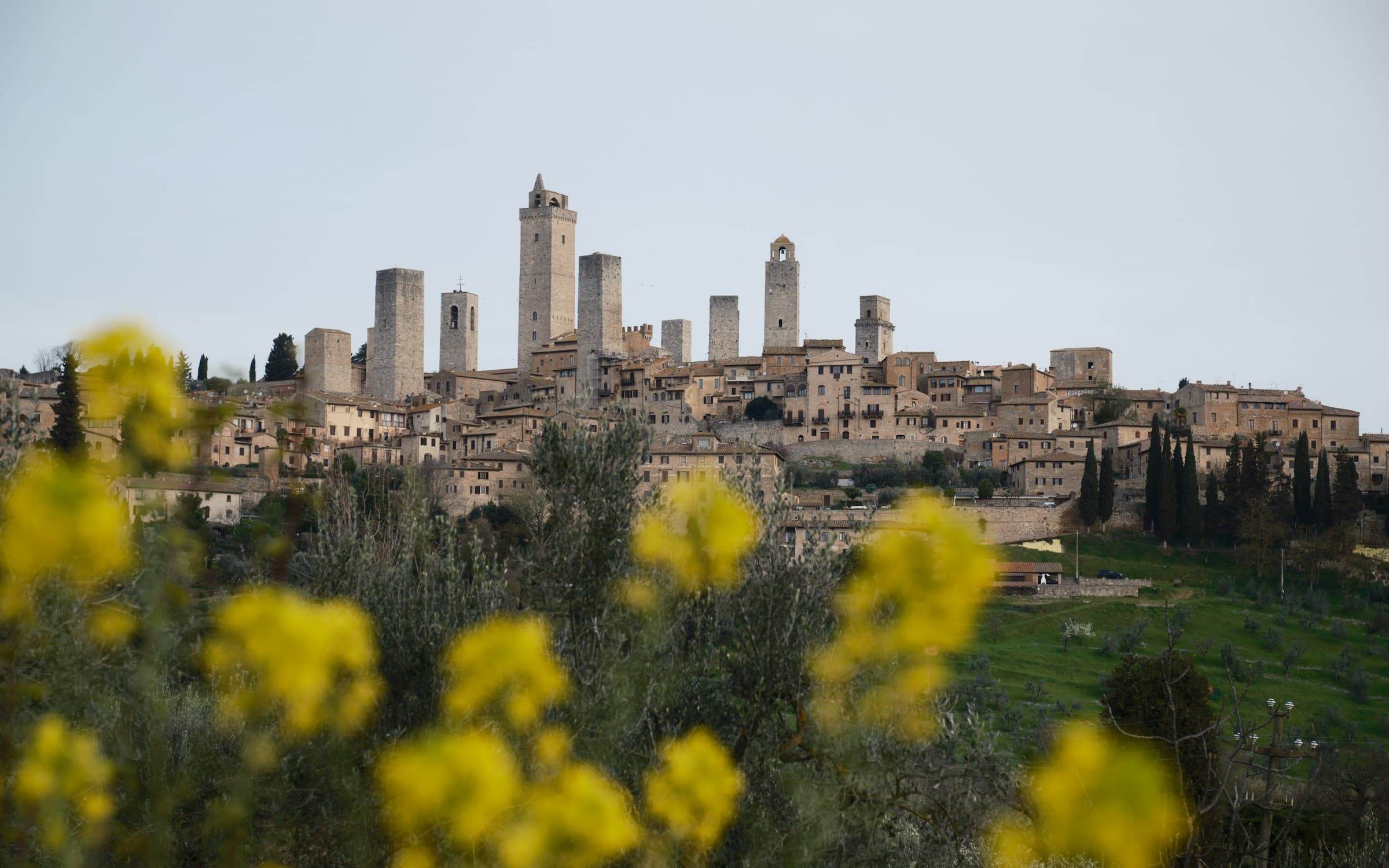
In the late morning, we reach San Gimignano, considered one of the main UNESCO sites in Tuscany, thanks to its characteristic medieval architecture.
San Gimignano is a small medieval town in the province of Siena. It stands on top of a hill overlooking the Elsa Valley and is a famous tourist city, whose unique collection of towers and winding streets makes it a fascinating destination for tourists. The city is also known for its white wine, called Vernaccia di San Gimignano.
Our walk begins at the city walls. We pass through Porta San Giovanni and walk along via San Giovanni, a street lined with old palaces, which climbs towards the city center.
Leaving Piazza della Cisterna behind, we head to Piazza del Duomo, which displays the most important buildings and palaces of San Gimignano.
To the left, at the top of a long staircase, we can admire the Cathedral of Santa Maria Assunta or Collegiata. It is a Romanesque church built in the 12th century with a stone and brick facade dating back to the 13th century. Inside the church is the Chapel of Santa Fina or Santa Serafina, who was a Christian Italian girl venerated in this city, and fantastic frescoes of the Sienese and Florentine school such as "The Martyrdom of Saint Sebastian" by Benozzo Gozzoli and "Stories of Saint Fina" by Ghirlandaio.
Our tour continues with the Town Hall, built in the 13th century and home to the Civic Museum and Art Gallery, and the magnificent Torre Grossa, which is the tallest tower in San Gimignano. From its top, we can appreciate the stunning view of the Tuscan countryside: beautiful Tuscan hills with villages, villas, woods, and groves.
Opposite the Cathedral, we can see the Palazzo del Podestà, built in the 13th century and characterized by a stone and brick facade and a 52-meter high tower called La Rognosa, which is the second tallest tower in the city.
During the tour, we will stop at a local restaurant in the historic center, where you can enjoy delicious Tuscan dishes.
After lunch, we have an ice cream at the famous Gelateria Dondoli, where we can enjoy a wide range of flavors such as "Crema di Santa Fina", "Dolcenero", and "Sorbetto alla Vernaccia".
You can also wander through the cobbled streets of the city and reach the Rocca, a ruined fortress on the highest part of the hill. It is surrounded by parks and olive groves, where you can sit and admire the Tuscan landscape.
Our tour ends with a visit to the famous Wine Museum, which is a tribute to the quality and prestige of Vernaccia di San Gimignano. Vernaccia di San Gimignano is produced exclusively in the medieval city of San Gimignano and has been considered the most excellent white wine in Italy since the Renaissance.
Towards Colle Val d'Elsa
We continue our walk along the Via Francigena and reach the Benedictine Abbey of Monte Oliveto Minore. As we walk, we can see the Castle of Montauto and the Torraccia Chiusi, the castle-tower of the Abbracciabeni family.
From here it is easy to reach Molino d'Aiano, where Archbishop Sigeric stopped during his journey, and Colle Val d'Elsa, with its fascinating historic center and narrow alleys winding between stone walls.
This Tuscan village is famous for its crystal production and offers spectacular artistic treasures. Here we can admire the famous Cathedral of Santa Marziale, one of the main churches in Colle Val d'Elsa, and The House-Tower of Arnolfo.
Dinner and Overnight Stay
Dinner: Ristorante Arnolfo, located in a Renaissance palace, where you can appreciate refined and genuine Tuscan dishes
Overnight stay: Ostello Rifugio d'Elsa in Colle Val d'Elsa
Day 4: Monteriggioni

After an early breakfast, we head towards Monteriggioni. We pass Badia a Cornèo, a Lombard abbey that once belonged to the monks of Vallombrosa, and Bagni delle Caldaie, a thermal center dating back to the Etruscan-Roman period.
The itinerary continues along a tree-lined road to the fortified village of Strove, built in 994. We pass the Castle of Petraia and reach Badia a Isola, where it will seem as if time stopped 1000 years ago, when Archbishop Sigeric stopped. Here we can see an important monastery built in the 10th century.
Subsequently, we can visit the Romanesque Abbey of San Salvatore a Isola, which dates back to 1001. For many centuries, this was a very important stop for pilgrims traveling to Rome.
Leaving Abbadia a Isola behind us, we will take a pleasant walk along the panoramic route of the Via Francigena between this small village and the village of Monteriggioni and appreciate the Tuscan countryside dotted with orchards, olive groves, and vineyards.
Monteriggioni
We stop at Monteriggioni, a charming city located on top of a hill, in the province of Siena. It is considered one of the best-preserved medieval cities in Italy and boasts magnificent outer walls with fourteen rectangular towers overlooking the Via Francigena.
After crossing the majestic Porta Romea (also known as Porta Franca) facing Florence to the north or Porta San Giovanni, we head towards Piazza Roma, the heart of the castle, built in the 13th century by the Republic of Siena for defensive purposes. The city stood on Monte Ala from which one could easily control the Elsa Valley and the Via Francigena.
In the square, you can admire the Church of Santa Maria Assunta, a Romanesque-Gothic church dating back to the 13th century. The facade features a beautiful portal with a stone arch, with a round window above.
Monteriggioni in Arme is worth a visit. The museum houses reproductions of medieval and Renaissance weapons and armor. Here we can have fun wearing ancient knight's armor on horseback and learn about the history of Monteriggioni.
Don't miss the experience of walking along the top of the castle walls from which we can enjoy breathtaking views of the wonderful countryside of the Chianti and Elsa valleys. We suggest taking a walk along the road outside the outer walls, looking for ancient inscriptions, walled entrances, and loopholes.
Lunch: Ristorante Antico Travaglio, where you can enjoy typical Tuscan dishes such as salami, homemade pasta and bread, and Florentine steak served with a refined selection of Tuscan wines.
In the afternoon, we can sit in a café, buy local wine in the picturesque wine shops, or visit the small shops in the city.
Dante and Monteriggioni
Monteriggioni is mentioned by Dante Alighieri in the Inferno in the Divine Comedy and one of his quotes is "Monteriggioni di Torri si Corona" (Monteriggioni crowns itself with towers). This quote gives its name to a medieval festival, which is celebrated here every year in July. Here we can find artisans, people in medieval costumes, knights, musicians, archers, and more. It is a great atmosphere and the perfect opportunity to go back to the Middle Ages!
The beauty of this place has attracted many Hollywood directors, and the city was the setting for the film "Gladiator".
Dinner and Overnight Stay
Dinner: Pizzeria Il Feudo, in Piazza Roma
Overnight stay: Casa per Ferie Santa Maria Assunta, a hostel for pilgrims located inside the walls
Transfer to Pisa airport for the return flight.
Practical Tips for Pilgrims
How to Prepare
The Francigena can be traveled on foot or by bicycle.
Trekking shoes are the best footwear for the journey. Trekking poles are also necessary because they increase balance. The backpack should be of excellent quality, have a volume of 35-45 liters, and contain an umbrella and a windbreaker. A medical check-up is recommended before leaving, as the journey is beautiful but difficult and tiring.
When to Go
The best months for a pilgrimage along the Via Francigena are May, June, September, or October.
For each section in Tuscany, the presence of the route's pavement is reported in percentage, so that a pilgrim can choose whether to do the route on foot or by bicycle.
It is useful to know that the Great St Bernard Pass is usually open only from the beginning of September, due to snow making it impassable for most of the year. The Cisa Pass can be covered in snow in late autumn or spring.
Supplies and Services
You can find water supplies, grocery stores, inns, cafes, restaurants, and hostels in most cities and villages along the Via Francigena. There are some areas where there are no water supplies or facilities for pilgrims.