Puglia has over 800 kilometers of coastline wrapped around the heel of Italy's boot. The Adriatic Sea runs along the east, the Ionian along the west, and they meet at Santa Maria di Leuca at the southern tip. This gives you options that most Italian regions can't match: rocky coves with deep blue water, long sandy stretches with Caribbean-clear shallows, and everything in between. But if you want to swim like a local, you need to understand one thing first: the wind decides everything.
The Rule Locals Live By

Here in Puglia, we check the wind before we check the time. The saying goes: "va dove ti porta il vento." Go where the wind takes you. This isn't poetry. It's practical.
When the Tramontana blows from the north, the Adriatic gets rough. Waves crash against the rocky coast, and swimming becomes a fight. On those days, head to the Ionian side, where the water stays calm. When the Scirocco comes up from Africa, bringing hot, humid air from the south, the Ionian gets stirred up and the Adriatic becomes glass. Apps like Windy or even just stepping outside will tell you what you need to know. If you're staying in Salento, the southern tip, you can drive between coasts in 30 to 40 minutes, so locals often decide the morning of.
For those visiting the Bari area further north, you're committed to the Adriatic. But the tradeoff is worth it: dramatic cliffs, turquoise coves, and beaches tucked into rocky inlets that feel hidden even when they're not.
Beaches in Bari City

You don't need to leave Bari to swim. Pane e Pomodoro is the city's main beach, a 10-minute walk from the old town along the lungomare. The name comes from an old tradition: families would bring bread and tomatoes for a simple lunch by the sea. It's sandy, shallow, family-friendly, and packed on summer weekends. Arrive before 9 AM for space. Beach clubs rent umbrellas and sunbeds, or bring your own towel for the free sections.
For something quieter, Torre Quetta sits a bit further along the coast. It's more spread out, with a mix of sandy areas and flat rocks. The water is clean, the vibe is calmer, and there's more room to breathe even in August.
North of the city, Giovinazzo offers pebble beaches and small coves along a coastline that earned Legambiente's Tre Vele recognition for water quality. Cala Arena has a mix of stones and sand with a gently sloping seabed, good for families. You'll find umbrella rentals, a bar, and paid parking.
South of Bari: Polignano and Monopoli

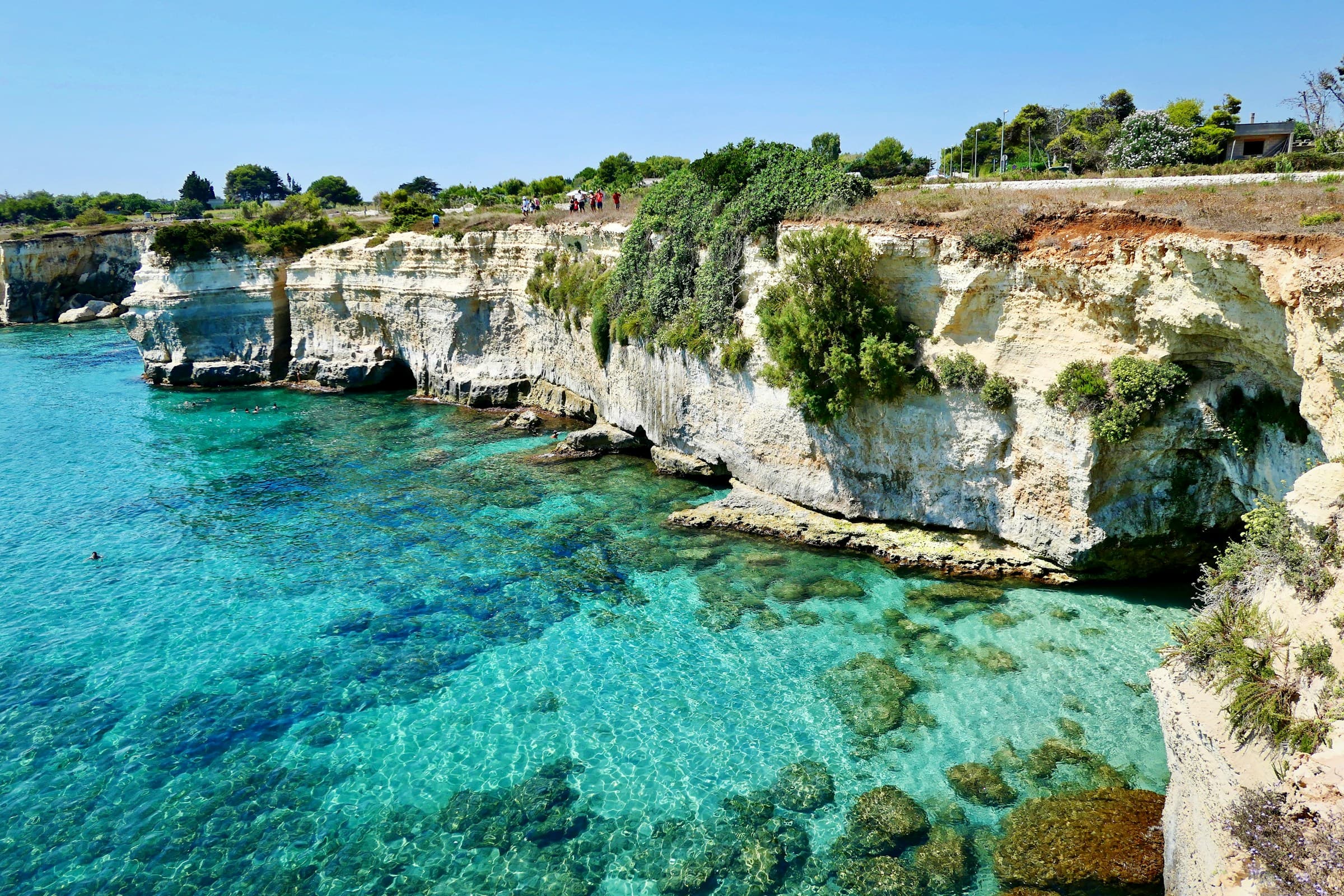
The coast between Bari and Monopoli is where the Adriatic shows off. Drive 30 minutes south and the landscape shifts to white limestone cliffs dropping into deep turquoise water.
Polignano a Mare is the famous one. Lama Monachile, the small cove wedged between towering cliffs below the old town, is probably the most photographed beach in Puglia. It's beautiful, dramatic, and absolutely mobbed in summer. The beach is pebbly, not sandy, and there's limited space. If you want to see it, go at sunrise or after 6 PM. For swimming, you're better off elsewhere.
Monopoli offers more variety and fewer crowds. The old town itself has Cala Porta Vecchia, a small sandy cove beneath the ancient city walls. It's photogenic and convenient for a quick dip while exploring the centro storico. One thing guides don't mention: outside peak summer, seaweed accumulates here until local authorities clear it, usually by late June. If you're visiting in May or early June, head south instead.
The real finds are the small coves dotted along Monopoli's coastline, all within walking or biking distance of town:
Porto Bianco has more sand than most Monopoli beaches and is entirely free. It's a 12-minute walk from the center, and there's a wheelchair-accessible ramp. Families fill it up on weekends, but the rocky areas on either side offer overflow space.
Cala Porto Rosso is my favorite beach in Monopoli proper. It's 20 minutes on foot from the center, past Porto Bianco. The inlet has warm, shallow water, decent sand, and rocky spots on both sides. It's free, with no facilities, so bring everything you need.
Porto Ghiacciolo, about 4 kilometers south of town, sits below the Abbey of Santo Stefano, an 11th-century structure built to defend against coastal raids. The name means "frozen port" because the water is noticeably cooler here. It's a locals' favorite with a small lido offering sunbeds and kayak rentals. Parking is free but limited. Arrive before 9 AM in July and August or you'll be walking from far away.
Cala Sottile and Cala Verde are further south and feel genuinely off the radar. The water is surreal. No facilities, no lidos, just rocks and sea. Park at San Stefano Campground and walk.
For supplies, stop at Panificio La Portavecchia before heading to the beach. Their focaccia Barese is some of the best in town.
Understanding Puglia's Two Coasts

If you're traveling beyond the Bari area, the Adriatic and Ionian coasts offer genuinely different experiences.
The Adriatic (East Coast) runs from the Gargano peninsula in the north down past Bari, Polignano, Monopoli, Ostuni, and through Salento to Otranto and beyond. The water is deep and intensely blue. The coastline alternates between dramatic limestone cliffs, rocky coves, and occasional sandy stretches. Swimming often means climbing down rocks or stairs carved into cliffs, then dropping into water that's immediately over your head. This coast is better for strong swimmers, snorkelers, and anyone who prefers dramatic scenery over soft sand. Towns like Polignano a Mare, Castro, and Otranto are built right on the cliffs with views that justify their popularity.
The Ionian (West Coast) faces the Gulf of Taranto and has a completely different character. Long sandy beaches stretch for kilometers, backed by dunes and pine forests. The water is shallow and calm, often light turquoise rather than the Adriatic's deep blue. Families with young children gravitate here. Pescoluse, called the "Maldives of Salento," has white sand and water so shallow you can walk out for hundreds of meters. Porto Cesareo and Punta Prosciutto offer the same Caribbean feel. This coast also gets more developed, with beach clubs and resorts lining the shore, and Gallipoli has become something like the Ibiza of southern Italy for younger crowds.
At Santa Maria di Leuca, the two seas meet. On a clear day, you can see the color difference from the Punta Ristola viewpoint. Boat tours from Leuca explore sea caves along both coasts and are worth the €25 to €40 cost.
Where to Go Based on What You Want
Best for families with kids: Ionian coast. Punta Prosciutto, Pescoluse, and Porto Cesareo all have shallow water and soft sand.
Best for dramatic scenery: Adriatic coast. Polignano a Mare's cliffs, the stretch from Otranto to Castro, and the coves around Monopoli.
Best for avoiding crowds: Cala Sottile and Cala Verde near Monopoli, or the smaller towns on the Ionian like Santa Caterina and Santa Maria al Bagno.
Best for a quick swim from Bari: Pane e Pomodoro for convenience, Torre Quetta for space, or take the 30-minute train to Monopoli and walk to Porto Bianco.
Best for snorkeling: Rocky Adriatic coves. Porto Ghiacciolo, the coast around Mola di Bari, and anywhere with a rocky seabed.
Practical Tips
Timing matters. In July and August, beaches fill by 9 AM. Locals often swim in the evening after 5 PM when crowds thin and the light turns golden.
Lido vs. spiaggia libera. Lidos are private beach clubs with umbrellas, sunbeds, bars, and bathrooms. They charge €15 to €40 per day depending on the location and season. Book ahead in August. Spiaggia libera means free beach. You bring everything, you clean up after yourself, and you find your own shade.
Don't walk through town in swimwear. Italians frown on this. Bring a cover-up if you're stopping for coffee or lunch between swims.
Rent a bike in Monopoli. The coastal path connects most of the beaches south of town. Pick one up at the train station for a few euros and explore.
Check the wind. I'll say it again. If the Adriatic is rough, drive to the Ionian. If the Scirocco is blowing, the Adriatic will be perfect. Let the wind decide.